
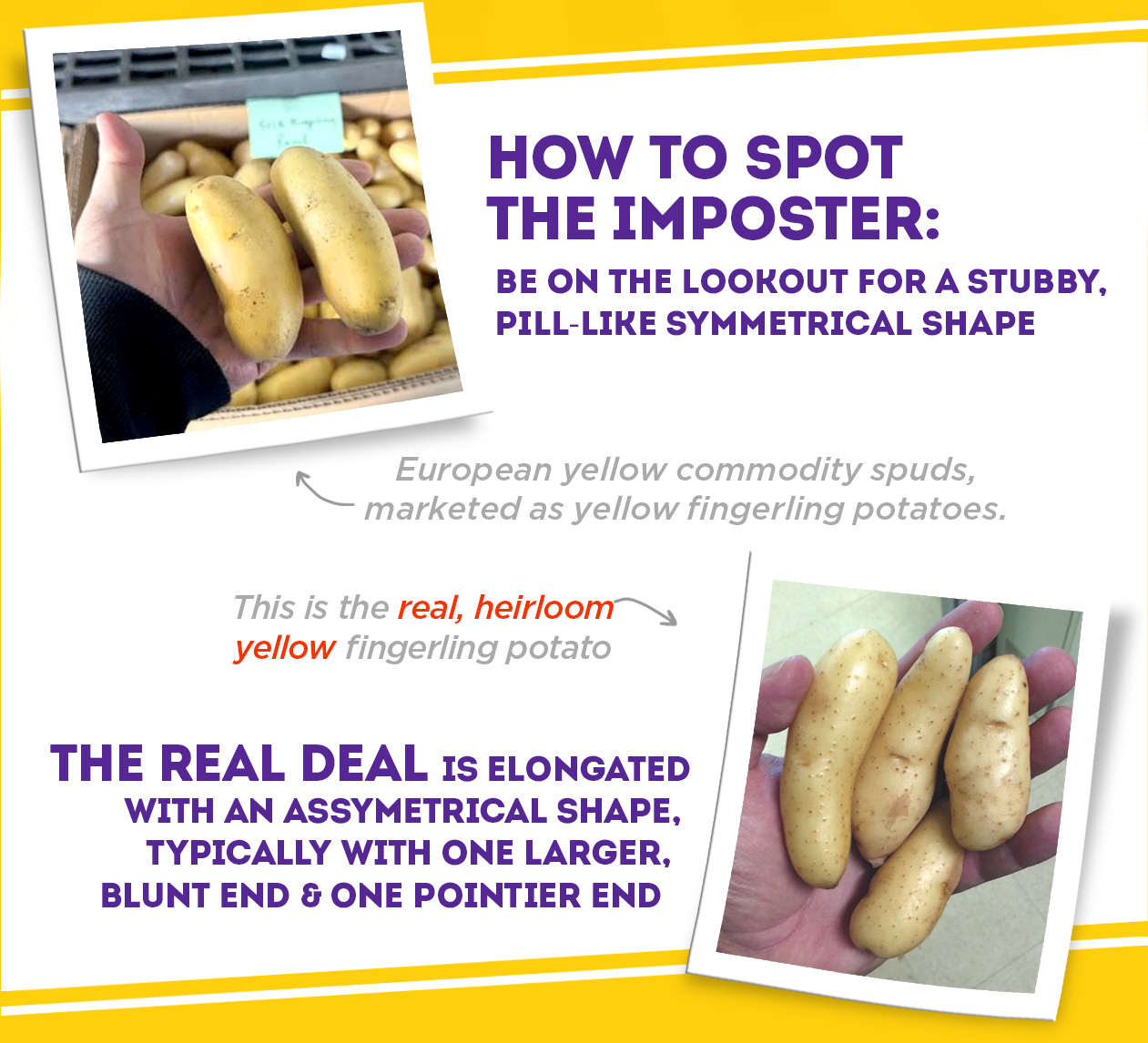
Fingerling potatoes are a category of finger-shaped heirloom potatoes that we commercially introduced in the 1980s to provide chefs with a year-round specialty potato option. Specialty produce was a rapidly growing segment of the industry by the mid-1980s. Prior to their introduction the closest thing to a specialty potato were seasonal creamer ("C-size") potatoes, which were just too unreliably available to be put on permanent menus. At the time, these "fingerlings" we were growing were all very old heirloom varieties. Some of them were not particularly finger-like in shape. As we entered the 90s, it became abundantly clear that the only really popular types were the three yellow fingerling varieties of Russian Banana, Austrian Crescent, and LaRatte. By the time much of the general public in the United States became aware of fingerling potatoes in the early 2000s, these yellow varieties constituted over 95% of the sales of fingerling potatoes. As such, these varieties became synonymous with the term ‘fingerling' potato.
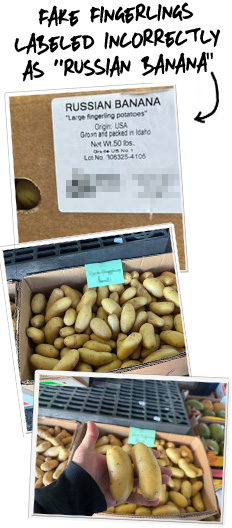
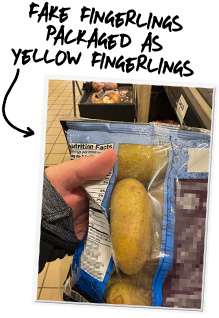 Fake yellow fingerlings are modern laboratory-bred varieties. All of these were created in Europe to be sold as regular commodity potatoes. In Europe, the most popular potatoes are yellow-fleshed. Europeans do not consume a lot of large potatoes, and specifically very few russet potatoes. So, in effect, these fake fingerling varieties are actually their version of the russet potato. They tend to have the common sweeter taste and more of a mid gravity than heirloom fingerling potatoes. Some of the fake fingerling varieties have essentially no flavor at all, as those varieties have been selected to have their flavor created with seasonings or oils.
 How to tell that you're being duped...
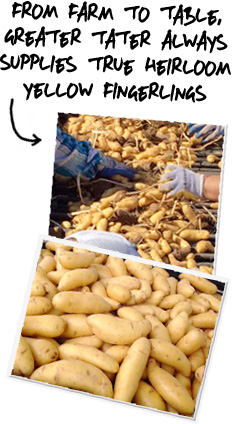
First of all, always choose Greater Tater. You will always get real heirloom yellow fingerling potatoes from us. The fake fingerlings yield 2-3 times the amount of potatoes per acre as real, heirloom fingerling potatoes, and what they actually are as a category are yellow "B-sized" potatoes. 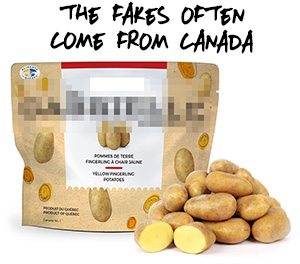 These are among the least marketable potatoes in table stock and typically return the least amount of money to the grower. So tricking people into buying them as "fingerlings" (even for a below-market price) is an absolute windfall for the marketer. The fakes often come from Canada, where they are more commonly found in grocery stores. Some of the other fakes we have pictured came from Idaho, the southwest, and midwest.
Why does it matter?This matters primarily to chefs. Fingerling potatoes originally gained popularity with chefs because they bring a different flavor profile than the ordinary one consumers can find in grocery stores. They tend to have an earthier, nuttier flavor which was closer to the normal flavor of potatoes in the 19th century. In the early 20th century, breeders in Europe created a sweeter yellow-fleshed variety called Bintje, which has eventually become the parent of the most popular potatoes in Europe. Fake yellow fingerlings are a derivative of these potatoes but, as with many fruits and vegetables today, varieties are unfortunately often selected for reasons other than flavor. Higher-yielding and easier to harvest varieties are more profitable, so too often selected at the expense of taste and health benefits. Chefs who are choosing fingerling potatoes for their flavor profile often find that the fake yellow fingerlings just don’t provide anything extraordinary.
As mentioned above, the primary reason is a cheaper cost of production. These modern varieties produce much larger yields than heirloom varieties and they are larger in diameter with more symmetrical shapes which makes them much easier to harvest and process with modern handling equipment.
Originally, in the early 2000s, these fake fingerling varieties were being used in the market as a retail product only. The primary reason was the cheaper cost to produce or purchase the fakes. The other reason was that the heirloom yellow fingerling varieties tend to green much faster under fluorescent lights than the fakes. All potatoes photosynthesize when exposed to light but these lab-bred varieties have been selected to not turn green, or to green much slower. Sometimes they even turn pink instead of green.
But they are photosynthesizing. Heirloom fingerling potatoes are very difficult to use in retail for this reason. They ideally need to be in a fully opaque package to prevent light exposure. But the consumers tend to believe that potatoes in a see-through mesh bag are healthier or more appealing in some way. This makes it very difficult for retailers to use real heirloom yellow fingerling potatoes. However, the greening is not an issue in restaurants because the heirloom fingerling potatoes are packaged in cartons and can remain out of the light.
The difficulty of mass marketing heirloom fingerling potatoes in retail creates a niche market for chefs who can provide a product to their patrons which those customers cannot so easily create at home.
 As one of the oldest continuous potato farms in North America, our family has grown all kinds of potatoes, including some of these varieties that are sold by others as fake yellow fingerlings - however we marketed them as their variety, not as a fingerling. They really are not consistently finger-shaped anyway, and tend to be more symmetrical, pill-shaped, and thicker in diameter. So we know from experience how they grow and yield and behave in different environments.
What you can count on from Greater Tater is that our yellow fingerling varieties will be heirloom only. They are the vast majority of the fingerling business we do and we want customers to trust that they are getting real heirloom yellow fingerling potatoes from us.